
Define the outcome
What Does ‘Work’ Mean for an Underarm Sweat Pad?
For a clothing-adhesive pad, “working” should describe an observable clothing outcome—not a change in how much a person sweats. The absorbent area receives moisture where it reaches the garment, remains positioned over that area, and helps limit how much moisture reaches visible outer fabric.
A practical setup also needs to remain reasonably flat and comfortable during normal movement. Its outline should be acceptable under the finished outfit, and checking or replacing it should be realistic for the day. A pad can absorb moisture and still be a poor match if it repeatedly folds, shows through the garment, or cannot cover the relevant underarm panel.
Effectiveness is therefore conditional. It depends on the overlap between pad coverage, garment construction, moisture location, movement, and timing. No single result applies to every shirt, wearer, activity, or day.
Simple mechanism
How Clothing-Adhesive Sweat Pads Work
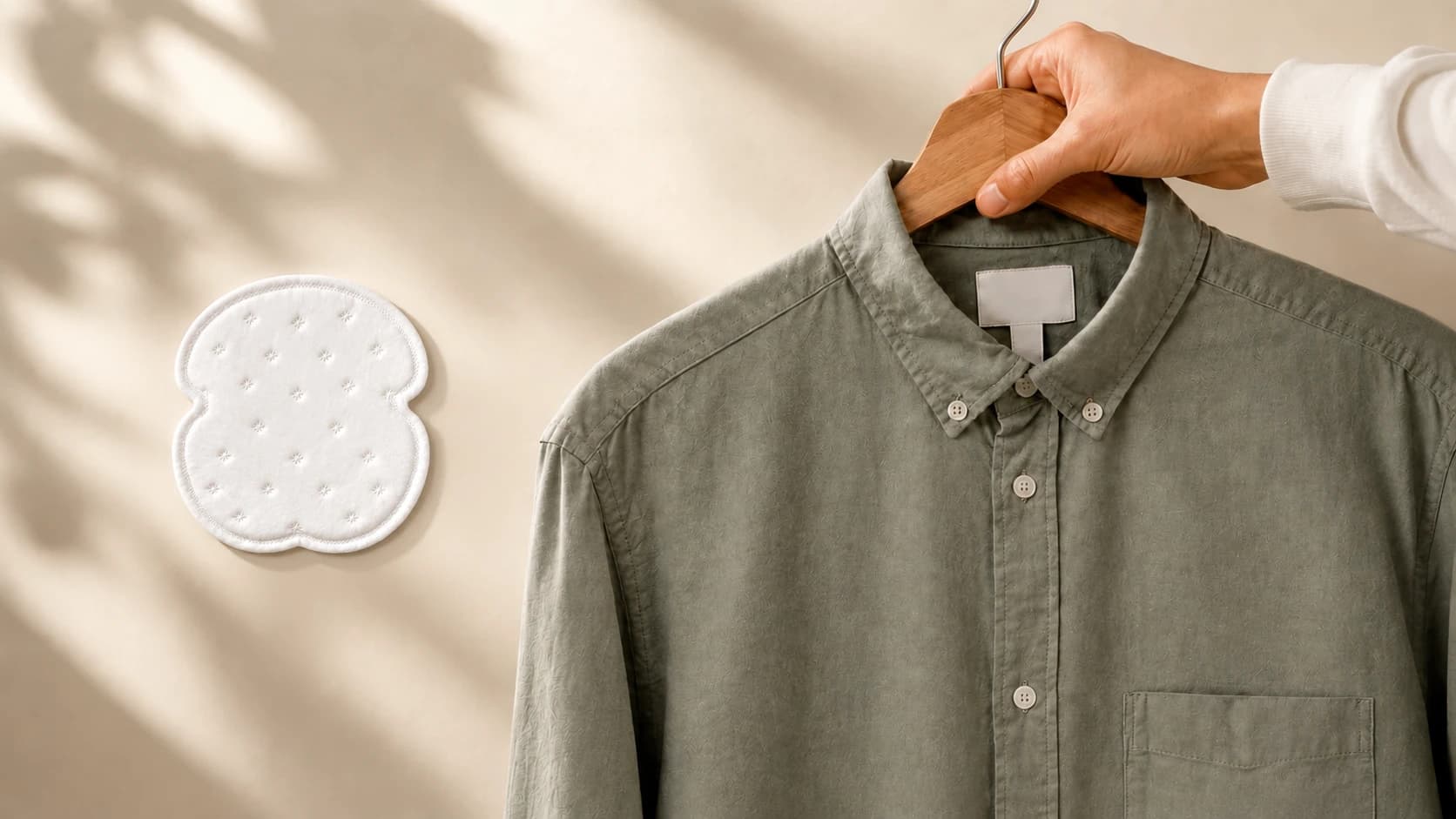
A clothing-adhesive underarm pad attaches to the inside of a garment. Its absorbent core sits between moisture reaching the underarm area and the visible outer fabric. After use, the pad is removed and discarded. SWEARX uses this disposable, individually wrapped format and is designed for clothing only, never direct skin application.
Clean, dry fabric and suitable contact area help the pad lie flat, but this article is not an application tutorial. For the complete preparation, seam-alignment, pressing, movement-test, and removal process, follow the guide to using underarm sweat pads inside clothing. To compare clothing-adhesive pads with skin-adhesive and reusable formats, visit the complete Sweat Pad Guide.
Realistic benefits
What Underarm Sweat Pads Can Help With
A removable absorbent barrier
The pad adds absorbent material at the garment underarm and can be removed after use. This may suit someone who wants protection for one compatible outfit rather than a permanent garment alteration.
Less moisture reaching visible fabric
When the absorbent area covers the right location, it can help limit moisture transfer and reduce visible clothing marks within that coverage. It does not protect fabric beyond the pad.
Outfit-specific flexibility
A pad can be tested with an individual dress shirt, uniform, travel outfit, or event garment. Suitability must be checked again when the garment or conditions change.
Protection without a full base layer
Pads concentrate material at the underarm instead of adding fabric across the torso. That can be useful when a full extra layer does not fit the outfit or preference.
Important limits
What Sweat Pads Do Not Do
- They do not stop perspiration or reduce how much the body sweats.
- They do not treat or cure hyperhidrosis and are not a substitute for professional medical advice.
- They cannot guarantee completely dry clothing, zero staining, or protection outside the covered area.
- They cannot guarantee invisibility under every fabric, color, fit, lining, or lighting condition.
- Clothing adhesive cannot be assumed to hold the same way on every smooth, textured, stretched, treated, or delicate fabric.
- There is no responsible universal wear-duration promise; pad condition can change with moisture, heat, activity, placement, and movement.
These limitations do not mean that the category is useless. They mean that success should be judged against a particular garment and situation, not an absolute marketing promise.
Performance factors
Why Sweat Pads Sometimes Don’t Work Well
Garment and fabric mismatch
A narrow armhole, bulky seam, lining edge, stretch panel, rough texture, or treated surface may leave too little smooth fabric for secure coverage. Delicate fabrics may also require extra caution before adhesive use.
Coverage or placement mismatch
If the absorbent area does not align with where moisture reaches the garment, visible fabric outside the pad can still become damp. Exact placement differs with garment construction.
Folding, edge lift, or shifting
Incomplete smoothing, interrupted adhesive contact, seams, fabric stretch, and normal arm movement can affect whether a pad stays flat. Detailed corrections belong in the application guide rather than being repeated here.
Moisture exceeds practical capacity
A pad can become saturated, especially when heat, activity, layers, stress, or moisture levels change. Continuing to wear a saturated pad can reduce useful clothing protection.
The finished outfit reveals the pad
Thin, light-colored, fitted, or structured clothing can reveal an outline or edge. A pad that looks discreet in an inside-out shirt may look different after dressing. Use the garment and fabric visibility guide for the complete outfit test.
Replacement is not practical
Travel, a long shift, or an event may limit private access for checking and changing a pad. A setup is less useful if its maintenance cannot fit the day.
For higher or less predictable moisture, the specialist guide to choosing pads when saturation risk is greater covers coverage, replacement planning, comfort, and suitability limits without presenting pads as treatment.
Practical evaluation
How to Tell Whether a Sweat Pad Is Working
Test the exact garment and complete outfit at home before an important workday, trip, presentation, or event. Use normal arm movement and inspect the result in the lighting where the clothing will be worn. Then check the pad’s condition during use when practical.
- The absorbent area aligns with where moisture reaches the garment.
- The pad remains reasonably flat instead of bunching into the seam.
- Its edges remain secure during the movement expected for the day.
- The setup stays comfortable when you raise, lower, and reach with both arms.
- The outline and edges are acceptable under the complete outfit in normal light.
- Moisture has not extended well beyond the area the pad covers.
- The pad is replaced when saturated, loose, folded, shifted, or uncomfortable.
This is an evaluation, not a promise. A pad may perform well with one shirt and poorly with another because the available fabric, seam position, fit, and movement pattern are different.
Situational fit
Who May Find Underarm Sweat Pads Useful?
Pads are most useful when their removable, concentrated format matches a real clothing need. The situations below are examples to test, not guarantees or universal recommendations.
Dress shirts and office clothing
A removable pad may suit a compatible shirt when you want underarm coverage without adding a full torso layer. The exact seam, fabric, fit, and outline still need an outfit test.
Uniforms and presentations
Pads may be practical when the garment provides a smooth usable underarm panel and the routine includes a private opportunity to check or replace them.
Travel and occasional events
Individually wrapped replacements are compact, which can suit a specific travel day, wedding, or event when changing access is realistic.
Avoiding a full extra layer
Someone who does not want a complete base garment may prefer protection concentrated at the underarm, provided the pad and outer garment work together comfortably.
For a broader routine that includes garment preparation, fabric, fit, and care, see how to reduce visible sweat marks on shirts.
Know the limits
When Sweat Pads May Not Be the Best Option
Another clothing-protection setup may be more practical when a garment has too little usable underarm fabric, the adhesive does not hold reliably, the pad repeatedly folds or shifts, or its outline remains too visible. The same is true when moisture saturates the pad too quickly for practical replacement or there is no private opportunity to check it.
Repeated daily use also involves application, replacement supply, removal, and disposal. Someone who prefers an integrated reusable routine may want to compare removable pads with sweat-proof undershirts. Neither option changes perspiration, and neither is ideal for every garment or situation.
Balanced decision
The Bottom Line
Underarm sweat pads can be useful clothing-protection tools, but “working” means absorbing moisture within suitable coverage while remaining flat, secure, comfortable, and acceptable under the intended outfit.
They do not stop sweating or guarantee dry clothes. Test the exact garment, judge performance by pad condition and visible clothing results, and choose another setup when fit, saturation, visibility, comfort, or replacement access makes the routine impractical.
Editorial disclosure: SWEARX sells disposable, clothing-adhesive underarm sweat pads. This guide describes both their potential use and their practical limitations. To review the verified SWEARX format without changing the article’s neutral conclusion, visit product details.
Buyer questions